Stephan Schmidt - December 16, 2025
Tech Strategy for CTOs
How you can create a clear, actionable technology strategy
TL;DR: Derive your tech vision from business strategy (not company vision), focus outward on how technology enables business success, then outline the key capabilities, people, and milestones needed to get there. A tech strategy should fit on a napkin and help everyone make the right decisions.
Most CTOs have no tech strategy. At most they have an idea for a tech solution and beyond the initial launch reactive to business demands and scaling challenges. Or they have a strategy in some slides from an old workshop that no one ever looked into again - full of buzzwords and corporate speak so no one remembers it - if it is a business strategy and not a tech strategy.
A tech vision and strategy are tools, not things to be put in a frame on the wall. They help your engineering team make the right decisions and focus on what matters. Coming to a fork in the road - should we build this or that? Should we refactor now or later? A clear tech strategy guides those decisions. Strategies that do not help techies make a decisions are not a good strategy.
Many CTOs avoid strategy. “I’m not a strategy consultant!” or “Strategy is too much work - I have fires to put out!”
They think tech strategy means a 30-page deck. Or something that happens once a year in a strategy offsite with post-its on the wall.
Strategy is simple. And you get better by doing it.
What is Tech Strategy?
Your tech vision is where you want your technology and engineering org to be in the future. A place that enables the business to win. A shiny and golden place everyone wants to be. Self explanatory and self motivating.
Your tech strategy is the plan to get there. It can be short - it can fit on a restaurant napkin. A tech strategy is a plausible plan to achieve your vision. It has the capabilities you need to build, the people you need to hire, and the milestones you need to hit.
Your strategy doesn’t need to be correct - you can’t predict the future. But it needs to be plausible. You adapt your strategy when new knowledge arises or circumstances change. The vision stays stable; the path to get there evolves.
There is more than one strategy to achieve your vision. If there is only one strategy, your vision might be not big enough. You select the one with the highest probability of success.
How CTOs Should Approach Tech Strategy
You derive your tech vision from your business strategy. Your vision is not about yourself, but outward, how you help the business strategy to succeed. This is an important point, where I see many mistakes being made.
If the business vision is to bring people to the top of Mount Everest, to enlight them by standing on the top and being overwhelmed by the view.
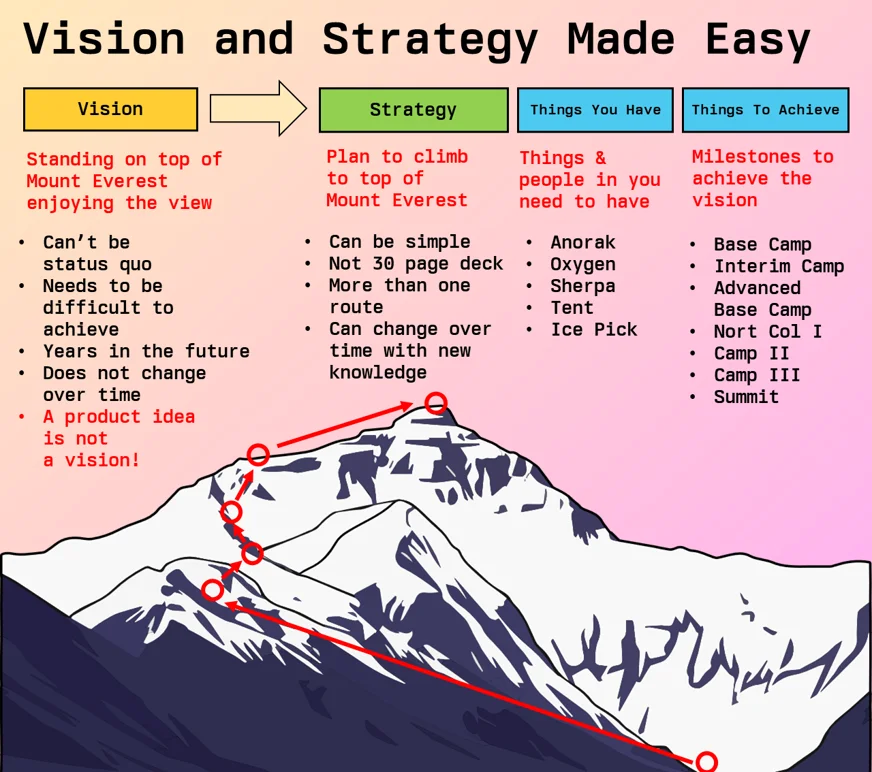
To bring people to the top of Mount Everest,
you might need:
- Anorak jackets
- Guides
- Ice picks
- Tents
- Oxygen
and milestones to achieve:
- Arrive at Mount Everest
- Base camp
- Interim camp
- Advanced base camp
- North Col I
- Camp II
- Camp III
- Summit
This plan sounds plausible. And as an exercise you can try to find wholes in your strategy and fill the gaps in your knowledge. Let me repeat, it doesn’t need to be correct: Assuming you want to go by truck from A to B, there are 3 milestones: bridges 1, 2 and 3. When you reach bridge 2, you find out that you can’t cross it with an 18-wheeler, because there is a construction going on. So you adapt your plan and wait for the construction to end, look out for another bridge or get two smaller trucks to cross the bridge. You adapt your strategy when new knowledge arises or circumstances change. You’re not chaning your vision to go to B.
There is more than one strategy to achieve your vision. If there is only one strategy, your vision might be not big enough. There is more than one route to the top of Mount Everest. And you can go with oxygen or without oxygen.
A tech vision needs to be how and what anorak jackets you provide. Or how you are able to provide the best effort. Or how you help business determine the best route to the top. Your vision is not determined by the company vision, otherwise you would build another company. Your vision is determined by business strategy - how business wants to get people to the top of Mount Everest.
A Tech Strategy Example
The business vision could be to connect people with their ancestors. And the business strategy would be to build a system where people can add stories about themselves and an AI avatar their children can talk to.
What are the key achievements and critical points in the business strategy related to technology?
Your tech vision would now be something like “To achieve an authentic presence by creating a generative model of an individual’s unique worldview.”
A strategy would be:
1. Things and people to have
- AI Research team to pioneer the core persona technology and push the boundaries of generative personality models
- Rapid Prototyping & Iteration Framework, enabling the AI team to quickly test new model architectures and get user feedback
- A specialized MLOps team for real-time infrastructure
- Persona Validation Process
2. Milestones to achieve
- End-to-end data processing successfully ingesting a life story
- Breakthrough in stylistic modeling by producing a text-only chatbot with subject’s unique voice
- First Worldview Inference model, capable of answering hypothetical questions
- Closed beta of the first embodied avatar
- Launch and rollout of avatars
There might be more and different ways to achieve your tech vision. The important point is: after reading your strategy, is it plausible that you’ll get there?
Does it give your team clarity on what to build and what to skip? Does it help you prioritize when everything feels urgent? Does it help engineers make the right call when you’re not in the room? Does it align people? Does it help people make the right decisions?
A vision and strategy do not need to be complicated, they do not need to be a 30-page deck or a strategy paper. A vision and strategy give guidance and are a tool to focus, prioritize, align and for everyone to make the right decisions.
About me: Hey, I'm Stephan, I help CTOs with Coaching, with 40+ years of software development and 25+ years of engineering management experience. I've coached and mentored 80+ CTOs and founders. I've founded 3 startups. 1 nice exit. I help CTOs and engineering leaders grow, scale their teams, gain clarity, lead with confidence and navigate the challenges of fast-growing companies.