Stephan Schmidt - January 12, 2026
7 Signs You Need a Fractional CTO
Patterns from hundreds of founder conversations - do you recognize yourself?
TL;DR: After hundreds of conversations with founders, certain patterns predict who needs a fractional CTO: non-technical founders burned by dev shops, tech leads drowning in strategic work they weren't trained for, investors asking hard questions, scaling bottlenecks, AI confusion, budget constraints that rule out full-time hires, and situations where you need experience more than hours. If you recognize yourself in two or more of these, it's worth a conversation.
After hundreds of conversations with founders and CTOs, I can usually tell within ten minutes whether someone needs a fractional CTO. The patterns are consistent. Same story, different names.
Here are the seven signs I see most often. If you recognize yourself in two or more of these, we should probably talk.
You’re a Non-Technical Founder Who’s Been Burned
Founders spend lots of money for very little being delivered, like 100k EUR on a dev shop that delivered a React app that had all the rough edges and crashed if more than 10 users logged in simultaneously. The shop was billing the founder for cleaning up bugs they created. They were totally steamrolling the founder. She was sitting on code nobody could maintain and a launch that was six months late.
This is the most common pattern I see. You had a great idea. You hired a dev shop or found some freelancers. You thought without management they would take care of everything - in your best interest. They built something. You have no idea if it’s good.
Maybe the agency disappeared halfway through. Maybe they delivered something that sort of works but you can’t tell if it’ll scale. Maybe you thought insourcing helps and are paying developers now and you have a gnawing suspicion they’re padding estimates - but you can’t prove it because you don’t speak the language. And that’s driving you crazy.
Sound familiar? I’ve talked to founders who were genuinely traumatized by outsourced development gone wrong. Hundreds of thousands of euros spent on code that needed to be thrown away their creditline blown on an idea. Timelines that slipped by months. Developers who nodded along in meetings and then built something completely different.
You need someone in your corner. Someone whose incentives are aligned with yours, not with billing more hours. Someone who can look at your code and tell you the truth - whether that’s “this is solid” or “you need to start over.” Someone who speaks both business and technology and can translate between you and your developers.
That’s what a fractional CTO does. Not to write code. To be your trusted technical advisor.
Your Tech Lead Is Drowning
You promoted your best developer to tech lead. Maybe even gave them the CTO title because you needed one on the cap table. Or you gave the first tech hire the CTO title. They’re brilliant with code. They know your system inside out.
But they’re struggling. They weren’t trained to manage people. Or they don’t want to. Or they don’t see it as their job. They don’t know how to push back on unrealistic timelines. They can’t explain technical trade-offs to investors. They’re spending all their time in meetings and the code is suffering. They’re burning out.
This isn’t their fault. The skills that make someone a great developer are different from the skills that make someone a great tech executive. Some people develop both. Many don’t. And that’s fine - not everyone wants to be a manager.
A fractional CTO can bridge this gap. Handle the executive work - investor communication, strategic planning, architecture decisions that affect the whole company - while your tech lead focuses on what they’re good at. Sometimes this is a permanent arrangement. Sometimes it’s temporary while your tech lead grows into the role (which takes time, but happens). Either way, it takes the pressure off someone who’s currently being asked to do a job they weren’t prepared for. It happens all the time.
Investors Are Asking Hard Questions
You have a board meeting coming up. Or a Series A pitch. Or due diligence for an acquisition. Someone’s going to ask about your technology strategy. What’s your answer?
“We’re building good software” isn’t a strategy. Neither is a vague hand-wave about AI. Investors want to know: How does your architecture scale? What’s your technical roadmap? Where are the risks? How do you know your team is productive? What happens if your lead developer leaves?
I’ve been on both sides of technical due diligence. I know what investors look for because I’ve been the one looking. The red flags aren’t always obvious to founders - they’re patterns that experienced technologists recognize immediately.
A fractional CTO can help you prepare. Audit your technology. Identify the problems before investors do. Help you tell a credible technology story. And be in the room when the questions get technical, providing the expertise that makes investors confident in your team.
This is often the trigger that gets founders to reach out. Fundraising is coming and suddenly they realize they need someone experienced at the table.
You’re Scaling and Tech Is the Bottleneck
Your company is growing. You’re hiring. Revenue is up. But somehow, features are taking longer, not shorter. Every sprint feels harder than the last.
This is normal - and it’s a sign that something needs to change.
The code your team wrote when there were 3 developers doesn’t work when there are 10. The architecture that handled 1,000 users creaks under 50,000. The informal processes that worked when everyone sat in the same room fall apart when you’re remote and growing.
You need someone who’s seen this before. Someone who’s scaled engineering teams from 5 to 50 and knows where the bottlenecks appear. Usually it’s not what founders think - it’s not that developers are slow, it’s that the system around them has become friction:
- Technical debt piling up
- Organizational debt growing
- Communication overhead exploding
- Testing gaps everywhere
A fractional CTO can diagnose this. Figure out what’s actually slowing you down and help you fix it before scaling makes it worse.
You’re Confused About AI
Everyone says you should be using AI. Your competitors are talking about AI. Investors ask about your AI strategy. You know you should be doing something, but you don’t know what.
Should you integrate ChatGPT? Build custom models? Use copilot tools? What’s hype and what’s real? How do you measure whether it’s actually helping?
I’ve been through technology hype cycles before. I was there when everyone said Java applets would replace desktop apps. That didn’t happen. I was there when everyone said you needed a mobile app. Sometimes you did, often you didn’t. AI is real, but not every AI feature is worth building.
This is where most companies are right now. Lots of pressure to “do AI” with very little clarity on what that means. I’ve seen startups spend six months building AI features that added no value. I’ve also seen simple integrations that saved developers hours every day.
The difference is usually strategy - knowing what problem you’re solving and what tool fits that problem. Not chasing the shiny thing because everyone else is talking about it.
| Usually Hype | Usually Real Value |
|---|---|
| "AI-powered" label on existing features | Copilot tools that save developers 2+ hrs/day |
| Custom ML models for simple problems | ChatGPT/Claude APIs for text processing |
| Chatbots that frustrate usersI | Integrating proven tools into existing workflows |
Most of my fractional CTO work right now involves AI strategy. Helping companies figure out what actually makes sense for their situation. What to experiment with. What to ignore. How to get developers to adopt new tools instead of resisting them.
You Can’t Afford a Full-Time CTO Yet
The math doesn’t work. A good CTO in Europe costs EUR 150-250k per year, plus equity, plus benefits. That’s EUR 15-20k per month before you factor in the 3-6 months of recruiting and the opportunity cost of not having anyone in the role.
You don’t have that budget. Or you do, but spending it on a full-time executive feels like burning runway when you could hire two more developers instead.
Here’s the thing: at your stage, there probably isn’t 40 hours of CTO work to do anyway. You need someone to make the right architecture decisions. Help with key hires. Talk to investors. Be there when things break. That’s maybe 10-15 hours a week.
A fractional CTO gives you experienced leadership at a price that makes sense. EUR 6-15k per month for 1-2 days a week of senior executive time. You get the experience you need without the commitment you can’t afford.
And when you’re ready for a full-time CTO - genuinely ready, with enough work and budget to justify it - a good fractional CTO will help you make that hire. The goal isn’t dependency. It’s getting you to the point where you don’t need external help anymore.
You Need Experience, Not Hours
Let me reapeat this: You need experienced leadership, not hours.
With a fractional CTO you get a very experienced CTO for less than an inexperienced one who is writing code.
This is the common thread running through all of these signs.
You don’t need someone to write code. You have developers for that. You don’t need someone to manage tickets. Your tech lead can handle that. What you need is someone who’s made these decisions before. Someone who can look at a problem and say “I’ve seen this pattern, here’s how it usually plays out, here’s what I’d do.”
Experience compounds in ways that hours don’t. A CTO who’s built five companies will make a critical architecture decision in 10 minutes that an inexperienced one would agonize over for weeks - and probably get wrong. The experienced one has made that mistake before. They know what it costs. They won’t make it again.
That’s what you’re paying for with a fractional CTO. Not hours - pattern recognition. The mistakes already made, so you don’t have to make them yourself.
What Now?
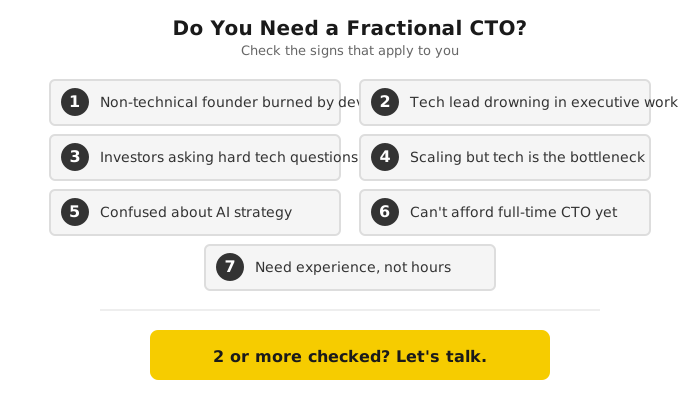
If you recognized yourself in two or more of these signs, a fractional CTO might make sense for you. Not definitely - every situation is different - but probably worth a conversation.
The best way to find out is to talk. In 30 minutes I can usually tell you what makes sense for your situation. Sometimes that’s “hire a fractional CTO.” Sometimes it’s “you actually need CTO coaching for your tech lead.” Sometimes it’s “you’re not ready yet, here’s what to do first.”
I’ll tell you the truth. Even if it means telling you that you don’t need me.
Book a call and let’s figure out what you actually need.
About me: Hey, I'm Stephan, I help CTOs with Coaching, with 40+ years of software development and 25+ years of engineering management experience. I've coached and mentored 80+ CTOs and founders. I've founded 3 startups. 1 nice exit. I help CTOs and engineering leaders grow, scale their teams, gain clarity, lead with confidence and navigate the challenges of fast-growing companies.