How to Become a CTO
Career Path & Roadmap from Developer to Chief Technology Officer
My personal story
Want to know how to become a CTO? Whether you’re a developer dreaming of the C-suite or a manager plotting your career path to CTO, this guide maps the complete CTO roadmap from developer to Chief Technology Officer. Let me tell you how I made the journey from developer to CTO and what it takes.
How can YOU become CTO?
Let us start with the Why. After some time as developer and later manager, I wanted to change things. I wanted to make development better. I wanted to make it run smoother. I wanted everyone to be happier. So I figured out that advancing the career ladder would give me more leverage. A team lead can change more things than a developer, a head of development more than a team lead. The ultimate tech position is that of the CTO, and therefore has the biggest leverage. I needed to become a CTO.
How to Become a CTO: The Career Path
What are the milestones and what are the new skills and responsibilities on each level?
A CTO career ladder looks like this: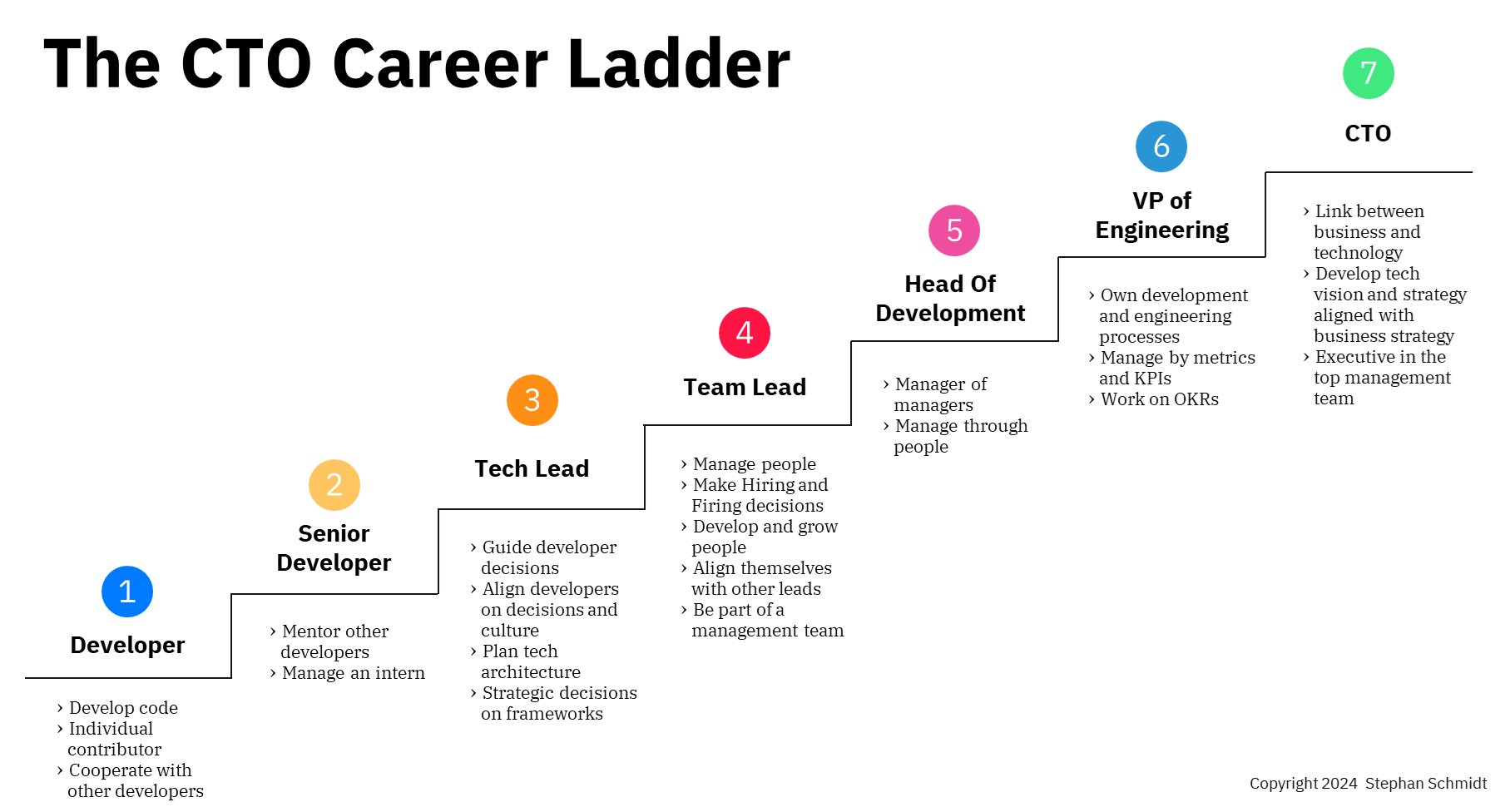
- Developer
- Individual contributor
- Develop code
- Cooperate with other developers
- Senior Developer
- Mentor other developers
- Manage an intern
- Tech Lead
- Guide developer decisions
- Align developers on decisions and culture
- Plan tech architecture
- Strategic decisions on frameworks
- Team Lead
- Manage people
- Make hiring and firing decisions
- Develop and grow people
- Align themselves with other leads
- Be part of a management team
- Head of development
- Manager of managers
- Manage through people
- VP of Engineering
- Own development and engineering processes
- Manage by metrics and KPIs
- Work on OKRs
- CTO
- Link between business and technology
- Develop tech vision and strategy aligned with business strategy
- Executive in the top management team
From Developer to CTO: My Journey
How to become a CTO? Did I follow that ladder (I skipped several levels ;-) At first, I’ve joined a startup as a developer. Soon I had to hire other developers and manage them. This way I became a tech manager early in my career. Then I founded a VC backed startup with two friends and got my first CTO title. Later I joined a larger company as an engineering lead. Yes, engineering lead, but this time for a larger company to have a large famous company on my résumé. Ad I wanted to become a CTO in a larger company, I would not listen to any recruiters who would not give me a CTO position. I would tell every recruiter I wanted another CTO position. That way I became a CTO in more companies and now work as CTO Coach so others can learn from my experiences.
Step 1: Start as a Developer
The first step on the career path to become CTO is to become a developer to start your tech career. This sounds obvious, but when looking at my CTO coachees and my career as a tech manager, most tech managers and especially chief technology officers come with a development background. Very, very few come from business, and only a few from QA or operations. If you are in one of these two groups, it might be better to become a developer first.
Sidenote: Product Manager to CTO
A second approach would be to make it through product management and become a CPO (Chief Product Officer) and then CPTO (Chief Product and Technology Officer).
Step 2: Advance Your Career (Developer to Manager)
There are several phases to becoming a CTO: A general career phase and a CTO phase.
If you want to make a career, you need to focus on the career. It does happen by accident to a certain degree and depends on chance. But without focus, it’s much harder to become chief technology officer. In the first phase, look out to advance your career. Focus on promotions and some job hopping—but stay at least two years with a company, or it looks bad on your résumé.
After some years up to the head of development position or to a VP of Engineering position, we enter the second phase.
Sidenote: Being promoted
Some notes on being promoted in general. The first rule of good promotions is the boss of your boss needs to know you by name—and what you are doing - and that you are great. Your team lead can promote you to senior, but she can’t promote you to team lead, but her boss can.
People will promote you if you are a problem solver. If you create a lot of fuzz, you might not get promoted, because your boss already has more problems than you know about. She does not want even more. But if you solve problems and reduce the number of problems on your own, you’re up for a promotion.
A common misunderstanding is that promotions are the reward for past performance. Promotions are not rewards for past performance, but assumptions about your future and solving open needs in the company.
Promotions are a risk to your boss (or bosses boss). It could be the wrong decision, so give your boss the impression and feeling that promoting you will be risk-less or even reduce the overall risk.
Step 3: From Manager to CTO
It is easier to get a good title and to be promoted in a startup. It may be your first CTO title, startups are desperate for CTOs. It’s a good idea to bounce between startups and larger companies. Advance your title and position with startups, then join a famous company for your résumé. Iterate to get the position you want.
With being an engineering manager on your résumé, it’s easier to get other engineering manager positions. Getting promoted inside a company to a higher position is easier than being hired to a higher position outside. It is important that you get a promotion inside a company. Sometimes this is not possible because the company does not have the money. Then get the new title without a pay raise as a cheap way out for the company. Remember you want to become CTO not get more money in every step, just over your whole career (when being interviewed, ALWAYS decline to mention your current/last salary. The only exception would be if it is >20% over the current market rate). If you are some years at a company, see that you get a change to your title. Sometimes people forget this, but it is important to get a better title every time it’s possible.
Some general notes on being promoted to CTO. Up to a senior developer or a team lead who codes, your coding and negotiation skills are most important. As a team lead and up, you need to focus on your people’s skills. Up to the CTO position, it is important to be excellent in technology. Your boss will value to a certain degree your tech skills.
In the CTO position, you’re the bridge to the rest of the company. As an C-level executive you are supposed to act across the company as part of the management team. The CEO will value your business understanding and translating business strategy into technology advancement much more than your inner understanding of Elixir and the Erlang VM. No one will respect you for your tech skills; everyone assumes that you’re good at tech, otherwise why are you CTO? Other skills will make you successful in the CTO position, especially explaining technology to business and translating business decisions into tech solutions.
Ready to Accelerate Your Path to CTO?
I’ve coached many engineering managers through this journey. If you want guidance from someone who’s been there - let’s talk.
TL;DR: The path to CTO runs through developer, senior, tech lead, team lead, head of development, VP Engineering. Two rules for promotions: your boss's boss needs to know your name, and promotions are assumptions about your future - not rewards for past performance. Bounce between startups and larger companies - advance your title at startups (they're desperate for CTOs), then join a famous company for your resume. Take title bumps without pay raises if needed; the title matters more than short-term money. The big shift at CTO level: nobody cares about your tech skills anymore - they assume you're good. What matters is translating business strategy into technology decisions. You become the bridge between engineering and the rest of the company.